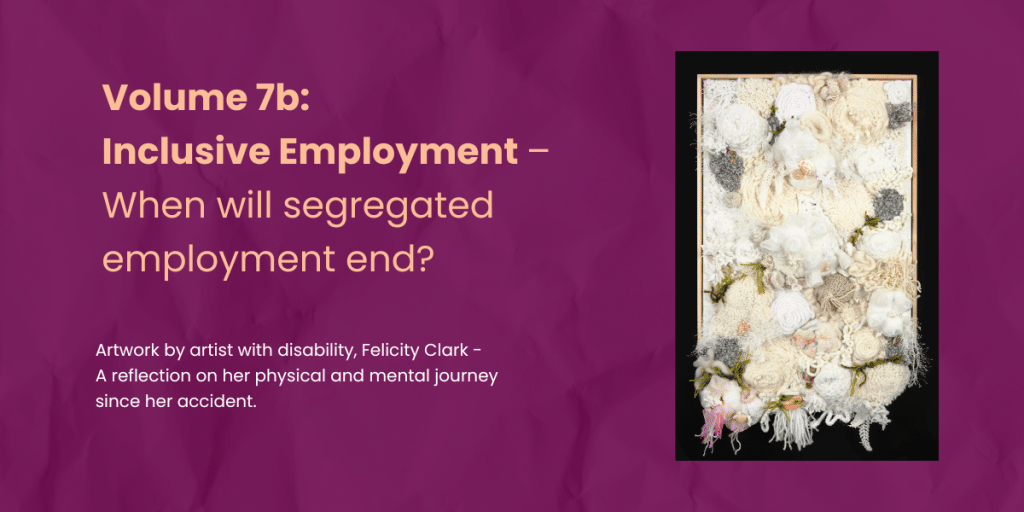
Artist Statement
“This piece is representative of the Barrier Reef’s slow destabilisation and destruction due to outside influences, but also reflects my physical and mental health journey since my accident. Amongst the decay and despair there is a renewal of hope with slow regrowth/rebirth toward a more positive future”.
-Felicity Clark
Technique:
Multiple textile techniques including hand stitching, soft sculpture, crochet and weaving
Materials:
95% recycled materials including repurposed yarns and fibres, laces, second hand clothing, floristry flower covers, shells, antique buttons and recycled jewellery, all hand stitch onto canvas and framed.
Inclusive Employment
Employment is about more than earning a wage.
In this post, we dissect Volume 7B of the DRC, which focusses on inclusive employment. The DRC describes how employment gives people with disability the opportunity to work, earn a living, and participate as an economic citizen – each being a core human right. Yet many people with disability continue to face significant barriers to securing and maintaining meaningful employment. Some also remain in segregated employment, where wages can be substantially below the national minimum wage.
The DRC called on governments to create a more inclusive employment system by:
- Increasing employment opportunities for people with disability, including through public sector employment targets and an “open employment first” approach for NDIS participants
- Strengthening workplace rights and legal protections for workers with disability
- Improving complaints and dispute resolution processes
- Raising subminimum wages for people working in segregated employment, with the goal of transitioning away from segregated employment by 2034
What QIDAN found
Compared to the other DRC volumes we have analysed, Volume 7B shows some of the strongest implementation progress by governments to date.
Better access to employment
Governments have begun implementing Recommendations 7.18–7.23, which aim to increase employment opportunities for people with disability across the public sector.
The National Disability Insurance Agency has also begun embedding an “open employment first” approach through the NDIS Participant Employment Strategy, reflecting Recommendation 7.29.
Stronger workplace protections are beginning
The Australian Government has commenced work on Recommendations 7.25 and 7.26, which propose amendments to the Fair Work Act 2009 and the Disability Discrimination Act 1992 to strengthen the rights and protections of workers with disability.
Progress on segregated employment remains limited
While there has been encouraging movement in several areas, QIDAN found little evidence of meaningful progress on one of the most significant issues raised by the Royal Commission: ending segregated employment.
Although governments undertook consultation on supported employment during 2025, there has been no clear commitment to increasing subminimum wages for people working in Australian Disability Enterprises or to implementing a pathway towards ending segregated employment – arguably the most critical of recommendations in this section.
For many people with disability, this means continuing to work for wages well below the national minimum wage (people in segregated employment are paid less than $10 an hour) while waiting for meaningful reform.
The DRC recognised that inclusive employment is about more than access to work. It is about ensuring people with disability have the same opportunity as everyone else to earn a fair wage, build a career, achieve financial independence and participate equally in Australia’s workforce.
Where things stand overall
According to QIDAN’s analysis:
- 2 recommendations (12%) have no updates on their implementation
- 10 recommendations (59%) are beginning to be implemented
- 3 recommendations (17%) are in progress, and
- 2 recommendations (12%) have been implemented
Continuing progress and close monitoring will be essential to ensure people with disability have equitable access to meaningful employment, fair wages and the same opportunities to thrive in the workplace as every other Australian.
That’s why we’re building the DRC Tracker – an independent, accessible online tool that will help everyone stay updated on what has been done and where the gaps in implementation are, so we can hold governments to account.
Help us track progress
You can help by donating to support the development of the DRC Tracker, and our continued monitoring of implementation.
Support The DRC Still Matters Campaign
Here are some other ways you can support the campaign.
Read our detailed analysis of Volume 7B in this mini report:
 View PDF (404 KB)
 View Word (1 MB)