Artist Statement
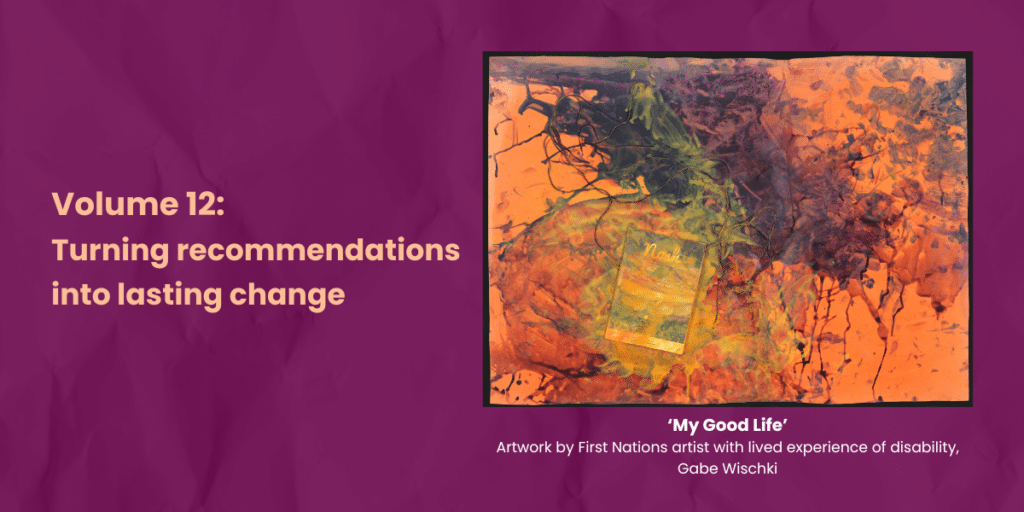
“My Good Life” is an acrylic painting on coloured cardboard with string and magazine which is strongly connected to Gabe’s sensory appreciation. This work represents a freedom to express himself and be included in places that belong to everyone. Gabe is a known member of his local community from which he collects magazines to peruse and meet his sensory needs.
Gabe’s art involves rubbing his hands and pushing his fingers through the paint. Gabe loves the thick quality of acrylic paint squeezed between his fingers and wiped across his face and body. He also enjoys manipulating various materials through the paint. The painting’s surface plays a significant role in creating the artwork, as it is folded and manipulated into various positions to capture the paint. The use of varied materials in combination with his hands serve as a way for him to connect with his Aboriginal heritage. Being non-speaking, Gabe’s art is a way to further communicate, enrich and connect with his community.
– Gabriel Wischki, Mixed Media Artist
Ensuring the DRC is implemented
Our final blog in this series explores Volume 12 of the Disability Royal Commission (DRC), which focuses on one of the most important questions of all: How do we ensure the DRC recommendations are implemented and governments remain accountable?
Volume 12 sets out a roadmap for implementing the DRC recommendations and establishing the systems needed to monitor, evaluate and publicly report on progress. The DRC recognised that meaningful reform requires more than commitments — it requires transparent reporting, independent oversight and disability leadership to ensure governments deliver on the changes they have promised.
To achieve this, the DRC recommended that governments:
- Respond formally to the DRC and commit to implementing its recommendations.
- Empower the Disability Reform Ministerial Council to oversee implementation as a national priority.
- Establish a National Disability Commission to independently monitor, report on and evaluate progress.
- Improve the collection and use of nationally consistent disability data, including ongoing investment in the National Disability Data Asset.
What QIDAN found
Governments responded — but too slowly
Recommendation 12.1 called for governments to provide a formal response to the DRC.
While governments did eventually respond, those responses were significantly delayed. QIDAN’s analysis also found that many responses overstated progress or did not accurately reflect the status of implementation, making independent monitoring even more important.
Independent oversight is still missing
Recommendations 12.3 and 12.4 call for the establishment of a National Disability Commission to independently oversee, monitor and evaluate implementation of the DRC.
QIDAN found no progress on either recommendation.
The National Disability Commission is intended to play a central role in monitoring implementation across the DRC, and several recommendations throughout the Final Report rely on its establishment. Without it, there is no independent national body responsible for assessing whether governments are delivering meaningful reform.
Better data is still needed
Recommendations 12.5 to 12.7 call for nationally consistent disability data to better understand outcomes for people with disability and measure the impact of reforms.
While governments have indicated they are working towards these recommendations, QIDAN found little publicly available evidence demonstrating measurable progress.
Where things stand overall
According to QIDAN’s analysis:
- 2 recommendations (24%) have been implemented.
- 3 recommendations (38%) are in the beginning stages of implementation.
- 3 recommendations (38%) have no implementation updates.
Why this matters
Volume 12 reminds us that recommendations alone do not create change.
Without independent oversight, transparent reporting and reliable data, it becomes difficult for people with disability, advocates and the broader community to know whether governments are delivering on the commitments made through the DRC.
This is why the DRC Tracker matters.
Help us track progress
Throughout this blog series, we’ve examined progress across all 12 volumes of the DRC. While some recommendations are beginning to move forward, many remain stalled, delayed or unimplemented.
The DRC Tracker will provide an accessible, independent way to monitor implementation, helping people with disability, their families, advocates, policymakers and the wider community stay informed and take action where required.
Donations support the development of the DRC Tracker and our ongoing monitoring of the DRC recommendations.
Support the DRC Still Matters Campaign:
Here are some other ways you can support the campaign.
Read our detailed analysis of Volume 12 in this mini report:
 View PDF (465 KB)
  View Word (2 MB)
Thank you for following our analysis of the DRC. Together, we can help ensure the voices that shaped it continue to drive lasting change.