Artist Statement:
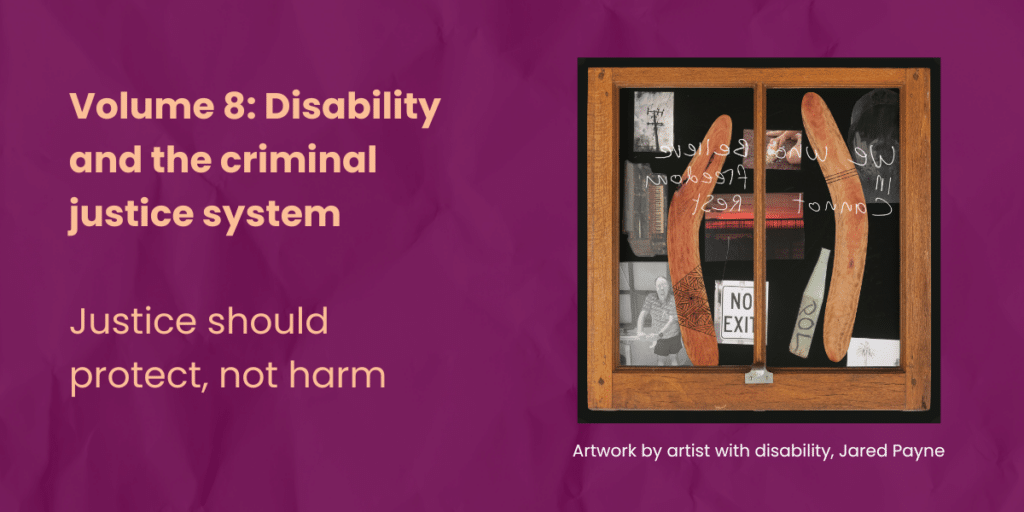
My name is Jared Payne, I am a Barkindji Man from far west New South Wales. The central art pieces are the two hand carved boomerangs for the two areas, the disability sector and the prison system. The Boomerangs themselves represent an ongoing practice of creating and curating amongst First Nations people regardless of the systemic and political factors that seek to erase this.
The window the boomerangs are placed in is from a 1930’s Queenslander house representing the distance between people on the inside and those who are kept on the outer. I have chosen to keep the window unlocked to represent the potential for people to look outside of their world and into others. All you have to do is to be willing to try. Open the window, look inside and engage with the carvings. They are made to be picked up, held, thrown, and clapped together. Please don’t treat them as fragile because they are not.
The photos in the background contextualise the work and have been taken by me over the last two years in different places on this continent. The man pictured in the bottom left corner is my uncle who has lived with multiple disabilities for many years. After being in a car accident he was told he would never walk again. He was a carpenter when he was young and built himself a set of parallel bars and taught his legs to walks again. The tools I carve with were given to me by him as he can no longer use them.
The writing on the glass of the window reads “we who believe in freedom cannot rest”, a quote from African American Civil Rights Activist, Ella Baker, which was amplified by Acapella band Sweet Honey and the Rock. This quote is included as a call to action for those who believe in freedom to fight for it, especially in response to the violence of policing and prison systems.
This artwork is attributed to those living with disabilities, their carers, and families as well as people with experiences of the prison system and their determination and steadfastness in addressing structural inequalities and institutions. The title of the song which carries this quote is ‘Ella’s Song’, paying tribute to my nan, Ella who has spent decades advocating for people in prisons and for people living with disabilities like my Uncle who she still cares for.
Justice must be accessible for everyone
Volume 8 of the Disability Royal Commission (DRC) examines the experiences of children, young people and adults with disability in Australia’s criminal justice system. It highlights the over-representation of people with disability throughout the system and the disproportionate risk of harm they experience while in custody.
The DRC found that improving outcomes requires more than policy reform. It called for practical, structural and cultural changes that would make the justice system safer, more accessible and more responsive to the needs of people with disability.
Among its recommendations, the DRC called on governments to:
- Improve conditions for people with disability in custody, increase access to disability supports and reasonable adjustments, and strengthen transition planning when leaving custody.
- Increase disability awareness and capability across the criminal justice workforce, while introducing culturally safe disability screening processes, particularly for First Nations peoples.
- Prohibit the use of solitary confinement in youth detention and strengthen independent monitoring through a disability rights lens.
- Raise the age of criminal responsibility.
What QIDAN found
Progress is beginning—but mostly still on paper
QIDAN found that many of the updates to date involve changes to strategies, plans and policy documents that reflect the intent of the DRC’s recommendations. While this is an important first step, there is limited evidence that these commitments have translated into meaningful changes in practice.
Solitary confinement remains a serious concern
Recommendation 8.3 calls for the prohibition of solitary confinement in youth detention. While the Queensland Government has stated that solitary confinement does not occur, QIDAN’s analysis indicates that restrictive isolation practices continue to be used within youth detention settings. This remains an area of significant concern.
Disability screening remains inconsistent
Some youth detention centres have begun piloting disability screening tools, representing early progress. However, QIDAN found little evidence of broader implementation across other custodial settings or action on Recommendation 8.16, which calls for culturally safe disability screening processes for First Nations peoples.
Raising the age remains unresolved
Recommendation 8.22 calls on all Australian jurisdictions to raise the age of criminal responsibility. The Queensland Government explicitly rejected this recommendation and, to date, QIDAN has found no evidence of action towards its implementation.
Where things stand overall
According to QIDAN’s analysis:
- 37% (7) of recommendations have no implementation updates.
- 58% (11) are in the early stages of implementation.
- 5% (1) have been rejected.
Most significantly, not one recommendation in Volume 8 has been fully implemented.
The Disability Royal Commission recognised that people with disability deserve a justice system that protects their rights, safeguards their wellbeing and provides equitable access to justice. While governments have begun laying policy foundations, meaningful reform will require sustained action that delivers real improvements for people with disability.
Help us track progress
Donations support the development of an accessible, independent DRC Tracker and our ongoing monitoring of the implementation of the Disability Royal Commission’s recommendations.
Support The DRC Still Matters Campaign
Here are some other ways you can support the campaign.
Read our detailed analysis of Volume 8 in this mini report:
 View PDF (483 KB)
 View Word (1 MB)