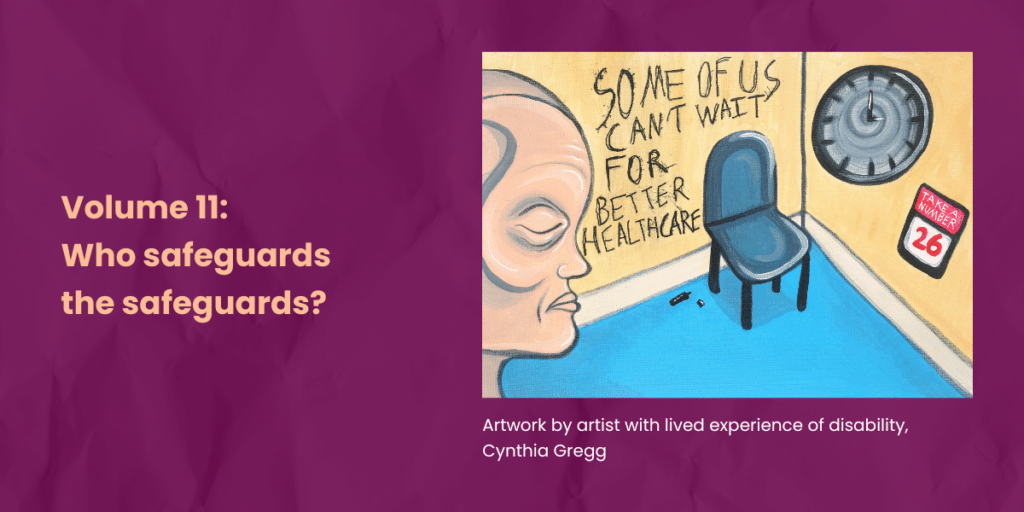
Artist Statement
“This painting is about the lack of inclusion and support for those with mental health concerns, within the healthcare system. I have found that in seeking help from mental health services – there are extraordinarily long wait times, often in uncomfortable rooms that are sometimes unsafe; which is not appropriate. Too many people with disabilities are slipping through the cracks, because of the lack of appropriate services, which is unfair”.
– Cynthia Gregg
Independent oversight and effective complaints mechanisms
Volume 11 of the Disability Royal Commission (DRC) examines the importance of independent oversight and effective complaints mechanisms to protect people with disability from violence, abuse, neglect and exploitation.
The DRC recognised that harm can occur across all systems — not just within the NDIS. It found that people with disability need safe, independent pathways to report concerns, strong oversight bodies to investigate complaints, and nationally consistent safeguarding measures that prevent harm before it escalates.
To strengthen these protections, the DRC recommended that governments:
- Establish nationally consistent adult safeguarding functions.
- Create new independent complaints pathways and strengthen complaints handling and investigation processes.
- Fully implement the Optional Protocol to the Convention against Torture (OPCAT), including establishing National Preventive Mechanism (NPM) bodies.
- Strengthen Community Visitor Schemes across Australia.
- Establish a disability death review scheme.
- Create a nationally consistent reportable conduct scheme with appropriate oversight.
What QIDAN found
Complaints are still going unheard
Recommendations 11.3 to 11.5 call for new, independent complaints pathways and stronger complaints handling processes for people with disability experiencing violence, abuse, neglect or exploitation.
QIDAN found no evidence of progress on any of these recommendations.
Without trusted, independent pathways to raise concerns, many people with disability may continue to face barriers to speaking up or having their experiences addressed.
OPCAT implementation has stalled
The DRC also recommended that Australia fully implement the Optional Protocol to the Convention against Torture (OPCAT) to strengthen independent monitoring of places where people are deprived of their liberty.
Recommendations 11.6 to 11.11 focus on embedding these protections into Australian law and practice.
QIDAN found no evidence of progress across any of these recommendations.
This comes despite Australia’s Universal Periodic Review, where several countries urged Australia to fully implement its OPCAT obligations.
Where things stand overall
According to QIDAN’s analysis:
- 6% of recommendations are in progress.
- 6% are at early stages of implementation.
- 89% recommendations have no implementation updates.
Volume 11 has the highest proportion of recommendations with no updates across all volumes of the DRC.
Independent oversight and accessible complaints processes are essential safeguards that help ensure people with disability are protected, heard and treated with dignity. Without these systems, abuse and neglect can remain hidden, accountability is weakened, and opportunities to prevent harm are lost.
Help us track progress
The DRC Tracker will provide an accessible, independent way to monitor implementation of DRC recommendations, helping people with disability, their families, advocates and the wider community understand what progress is being made and where further action is needed.
Donations support the development of the DRC Tracker and our ongoing monitoring of the Royal Commission’s recommendations.
Support The DRC Still Matters Campaign
Here are some other ways you can support the campaign.
Read our detailed analysis of Volume 11 in this mini report:
 View PDF (508 KB)
 View Word (2 MB)