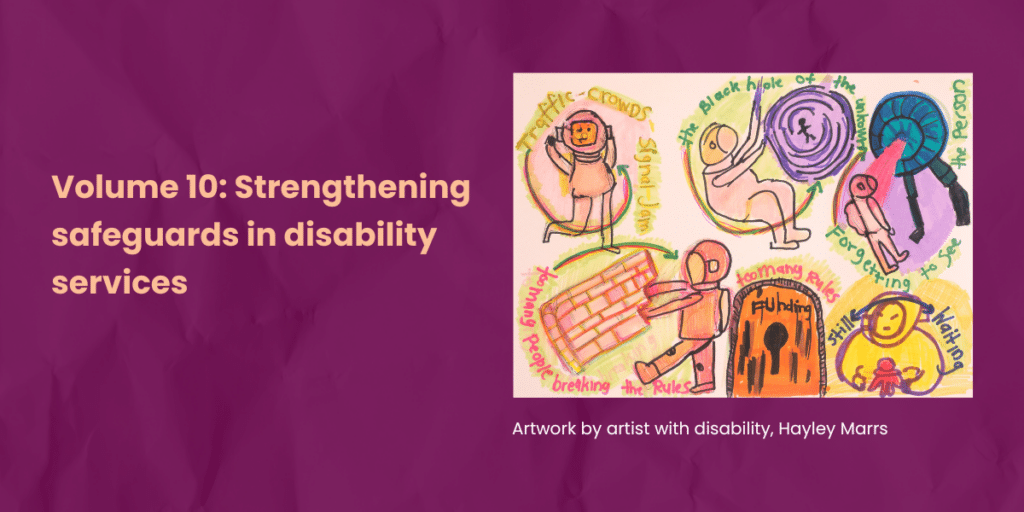
Artist Statement
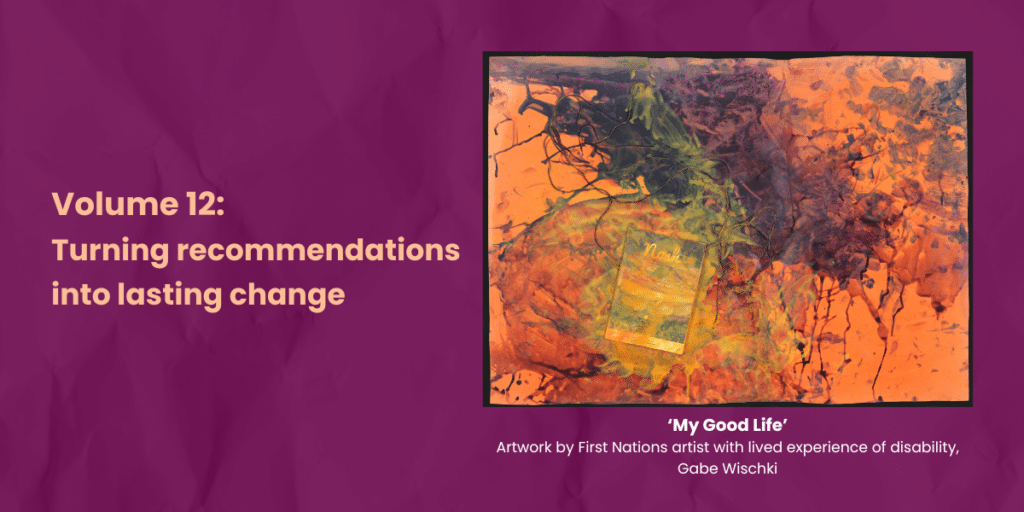
“My artwork represents how the world can be too loud, too bright, and too fast. The black hole of the unknown in my artwork is about how we don’t know what is happening to our disability supports. Support for people with disabilities is more and more limited; this support once improved how we got through each day.
It’s hard not being able to see the person telling us how much funding we get. They need to see how our disability affects us. They don’t live our lives, and they don’t see the invisible parts of our disability. Without support we are left to struggle to adapt.”
Ensuring they are safe, heard and supported
Volume 10 of the Disability Royal Commission (DRC) examines the quality and safety of disability services, and the systems responsible for preventing and responding to violence, abuse, neglect and exploitation.
The DRC uncovered widespread concerns about how disability services are delivered, monitored and regulated. It found that stronger safeguards, independent oversight and a greater focus on human rights are essential to ensuring people with disability are safe, heard and supported.
To address these issues, the DRC recommended reforms that would:
- Embed supported decision-making principles throughout disability service delivery.
- Improve access to independent support coordination.
- Strengthen complaints handling processes and independent oversight.
- Reform the NDIS Quality and Safeguards Commission to improve its effectiveness.
- Improve the reporting, monitoring and management of reportable incidents.
What QIDAN found
Choice and control remain overlooked.
Recommendations 10.6 and 10.7 call for supported decision-making principles to be embedded throughout disability service delivery, ensuring people with disability have greater choice and control over the supports they receive.
QIDAN found no evidence of progress on either recommendation. Supported decision-making is fundamental to protecting the rights, autonomy and safety of people with disability, and reducing the risk of abuse and neglect within disability services.
Limited progress on reportable incidents
The DRC recommended significant improvements to how reportable incidents are identified, managed and monitored.
While Recommendation 10.11 has been accepted in principle, QIDAN found little progress across the remaining recommendations. Without stronger monitoring and oversight, serious incidents may continue to go undetected or inadequately addressed.
Complaints are still not being heard
People with disability must be able to raise concerns confidently, knowing their complaints will be taken seriously.
Volume 10 includes four recommendations to strengthen complaints handling and oversight. QIDAN found that two of these recommendations have seen no progress, leaving important accountability measures yet to be implemented.
Where things stand overall
According to QIDAN’s analysis:
- 48% of recommendations have no implementation updates.
- 36% are in the early stages of implementation.
- 12% are in progress.
- 3% have been implemented.
The Disability Royal Commission made it clear that quality services depend on strong safeguards, effective oversight and a human rights-based approach to disability support. While some reforms have begun, many of the recommendations designed to strengthen accountability and protect people with disability remain unimplemented.
Help us track progress
The DRC Tracker will provide an accessible, independent way to monitor the implementation of the DRC’s recommendations, helping people with disability, families, advocates and the wider community stay informed and hold governments accountable.
Donations support the development of the Tracker and our ongoing monitoring of implementation across Australia.
Support The DRC Still Matters Campaign
Here are some other ways you can support the campaign.
Read our detailed analysis of Volume 10 in this mini report:
 View PDF (554 KB)
 View Word (2 MB)