Artist Statement
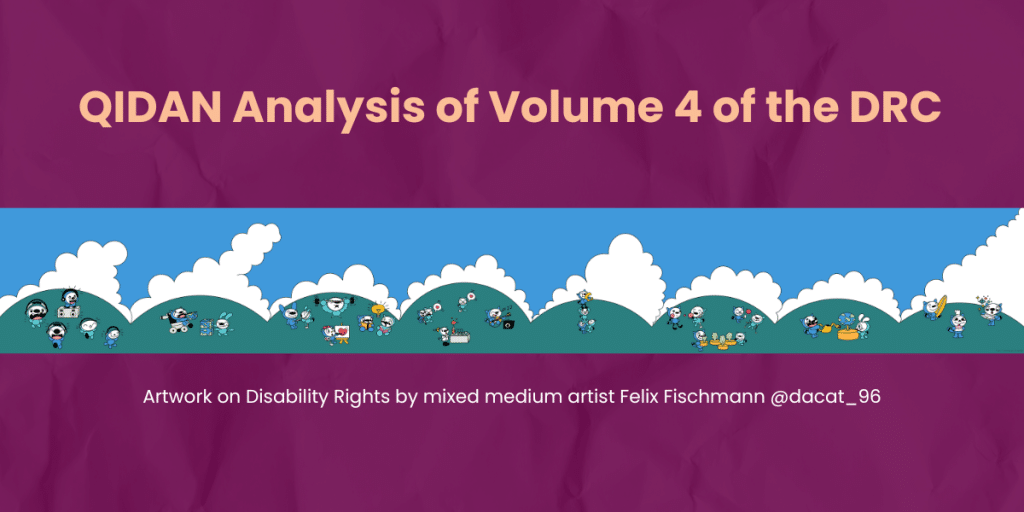
This artwork features a group of animal characters, bunnies and cats, helping each other overcome their disabilities. It’s a message that people with disabilities can achieve great things and discover new possibilities. The style is super flat, inspired by Takashi Murakami. My artwork draws on influence from Japanese cartoons, anime, Adventure Time, Looney Tunes and Disney cartoons.
– Felix Fischmann
Disability rights
Volume 4 of the Disability Royal Commission focused on disability rights — including calls for a Disability Rights Act and reform of the Disability Discrimination Act.
Progression on some recommendations made a strong start – but now they have stalled.
QIDAN’s key findings in Volume 4 include:
- No progress on the Disability Rights Act
There has been no movement on recommendations 4.1–4.22, which call for stronger, enforceable disability rights at a federal level. - Delay in Disability Discrimination Act reform
The Attorney-General’s Department started strong, initiating a consultation on the Disability Discrimination Act to inform their review. Unfortunately, progress seems to have stopped there, and there is no new news on the review. - Australia’s ongoing failure to implement the CRPD.
More than two decades after ratifying the Convention on the Rights of Persons with Disabilities, Australia still has not fully implemented its obligations.
QIDAN’s position on disability rights
QIDAN supports the DRC’s intent with the objectives of the Disability Rights Act, but we believe that the establishment of an Australian Human Rights Act would be more effective in intent and application.
We fully endorse the Human Rights Act Campaign, and the Human Rights Act private members Bill that was recently introduced in the House of Representatives.
A Human Rights Act would provide a stronger, more consistent framework for protecting disability rights, rather than relying on fragmented protections and discretionary policy approaches.
This need is particularly urgent in Queensland, where we are increasingly seeing the Queensland Government bend and ignore the state Human Rights Act for its own advantage. Without enforceable federal protections, disability rights remain vulnerable.
Where things stand overall
According to QIDAN’s analysis of Volume 4:
- 65% of recommendations have no public update
- 35% are only in the beginning stages of implementation
Governments have said they are committed to disability rights, but tangible legal reform has yet to materialise. For many people with disability, it remains unclear how, or when, these commitments will translate into stronger protections.
This week, we ask what would stronger disability rights look like?
Donations support the development of an accessible, independent online DRC Tracker, and our continued monitoring of the DRC implementation. We are trying to reach a goal of $20,000 by the end of the financial year so we can build the DRC Tracker. We are inviting people to make a 100% tax-deductible donation by 30 June 2026 so we can make this goal a reality!
Support The DRC Still Matters Campaign
Here are some other ways you can support the campaign.
Read our detailed analysis of Volume 4 in this mini report:
 View PDF (393 KB)
 View Word (969 KB)