Artist Statement
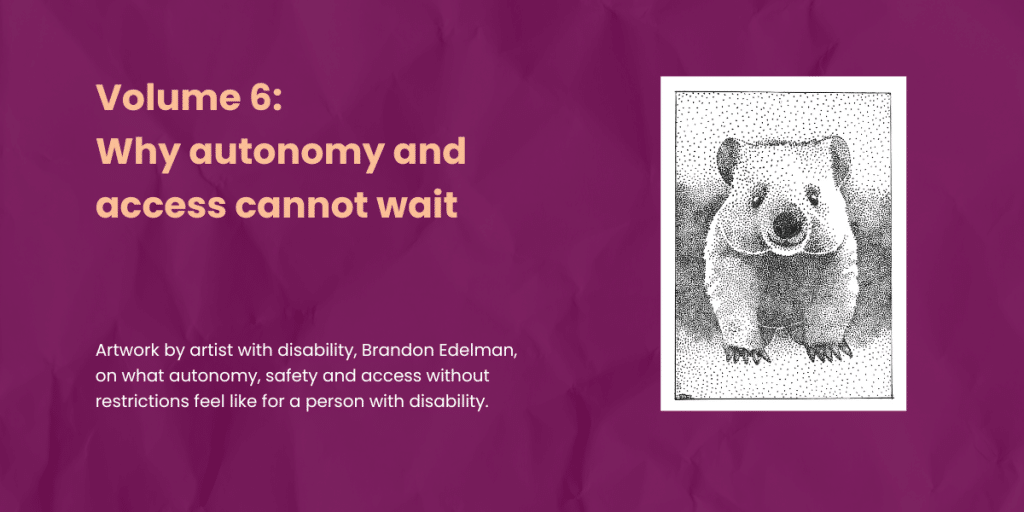
My artwork is based on a solitary native Australian animal. Whilst the animal lives most of its life alone, when it does find it’s community it finds happiness and belonging.
This is based on my own lived experience of finding a place that includes me and how it makes me feel.
– Brandon Edelman
Autonomy and Access
Volume 6 focuses on issues that directly affect people’s rights, safety and independence. Its 41 recommendations cover a wide range of areas, including accessible information and systems, supported decision-making, access to advocacy, and bodily autonomy. The DRC calls for significant changes to systems like the health system, the Office of the Public Guardian, and the Public Trustee.
These recommendations aim to ensure that people with disability have greater control over their lives and can access the support they need to make decisions, exercise their rights, and participate fully in the community.
In our analysis, we identified significant gaps in progress across several key areas.
What QIDAN found
No progress on supported decision-making
Recommendations 6.4 to 6.14 focus on supported decision-making, a cornerstone of autonomy, equality and inclusion.
Supported decision-making enables people with disability to make their own decisions with the assistance they choose, rather than having decisions made on their behalf.
Despite its importance, QIDAN found no evidence of progress on any of these recommendations.
No action to safeguard bodily autonomy
We also identified limited-to-no progress on recommendations 6.35 and 6.36, which call for stronger legal safeguards around the use of restrictive practices.
Similarly, we found no evidence of progress on recommendation 6.41, which calls on all jurisdictions to prohibit non-therapeutic sterilisation.
These recommendations relate to some of the most fundamental rights examined by the DRC, including the right to bodily autonomy, dignity and freedom from harm.
Where things stand overall
According to QIDAN’s analysis:
- 25 recommendations have no implementation updates
- 15 are beginning to be implemented, and
- 1 recommendation appears to be rejected
Volume 6 contains many of the DRC’s recommendations aimed at strengthening individual rights, safety and self-determination.
While there has been some early progress in a small number of areas, the overall pace of implementation remains slow. QIDAN is concerned that many recommendations central to autonomy, supported decision-making and safeguarding have yet to show meaningful progress.
As governments continue to consider the DRC’s recommendations, there remains an important opportunity to strengthen accountability and ensure that people with disability can exercise greater choice, control and autonomy in all areas of life.
Help us track progress
Donations support the development of an accessible, independent online DRC Tracker and our ongoing monitoring of Disability Royal Commission implementation.
The DRC Tracker will help people with disability, families, advocates and policymakers understand where progress is being made—and where further action is needed.
Support The DRC Still Matters Campaign
Here are some other ways you can support the campaign.
Read our detailed analysis of Volume 6 in this mini report:
 View PDF (587 KB)
 View Word (1 MB)