Artist Statement
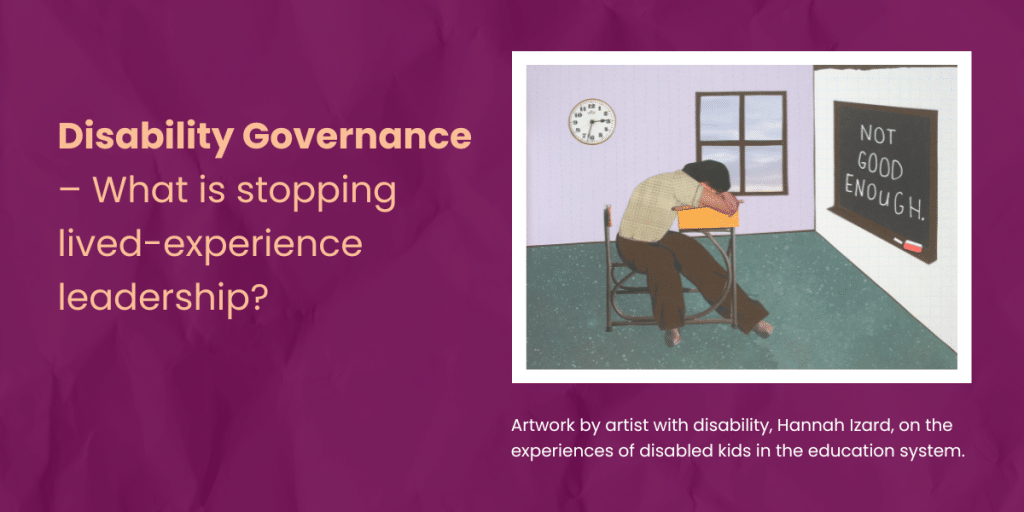
Not good enough
For this artwork, I thought about my own experiences growing up with Autism Spectrum Disorder, Dyslexia, and Severe Anxiety with no support available to me. I thought about the prompt “a moment when something felt unfair” and my experience in the education system came to mind. As an adult, I am doing art projects with students in secondary school that access the Inclusive Education Unit and I can see that a lot of the students are still having similar experience of not feeling good enough even though there is a lot more support available to them than when I was a student, so I feel that, even though I reference a time in my life that was almost 20 years ago now, it is still relevant to how students with disabilities are feeling today.
– Hannah Izard
Governance, leadership and accountability
At the heart of Volume 5 is a clear direction: lasting reform depends on stronger systems that centre the voices and leadership of people with disability.
When reviewing government action over the past two-and-a-half years, QIDAN has identified a consistent pattern. Recommendations focused on reviewing existing plans, policies and strategies have seen some early movement. However, recommendations that strengthen disability leadership and system accountability have seen limited or no progress to date.
What QIDAN found
No progress on disability leadership
Recommendation 5.5 calls for the establishment of a National Disability Commission to provide independent oversight and monitoring of disability outcomes. There have been no implementation updates.
Recommendation 5.6 proposes strengthened disability leadership within government, including a dedicated ministerial portfolio for disability inclusion. Due to the Government’s ongoing response to this recommendation, our analysis considers this rejected, as there is no intent to begin implementation.
Reviews are underway – and an opportunity to strengthen reform
Recommendations 5.2 and 5.3 call for reviews of key disability strategies, including Australia’s Disability Strategy, to ensure it reflects the Royal Commission’s findings and is shaped in partnership with people with disability and representative organisations.
This co-design approach is a consistent theme across Volume 5 and reflects the importance of ensuring people with disability are involved not only in consultation, but in shared decision-making and ongoing governance.
As these reviews progress, they also present an opportunity to strengthen alignment across government systems, ensuring disability outcomes are embedded in core policy areas such as housing and homelessness, health agreements, education and skills, employment strategies, emergency management planning, family and sexual violence frameworks, mental health, and Closing the Gap initiatives.
Where things stand overall
According to QIDAN’s analysis:
- 43% of recommendations in Volume 5 have no implementation updates
- 29% are beginning to be implemented
- Only 14% are making clear progress
- Recommendation 5.6 rejected
Volume 5 is clear that the challenge lies in governance, accountability and consistent implementation across systems.
The Royal Commission’s recommendations point to the need for:
- Stronger national leadership
- Clearer accountability mechanisms
- Independent monitoring of progress
- Consistent action across all levels of government
- Greater involvement of people with disability in decision-making
- A shift from measuring activity to measuring outcomes
- Disability inclusion embedded across all areas of government policy
This includes ensuring Australia’s Disability Strategy is co-designed with people with disability and representative organisations, and that Australia continues to strengthen implementation of the UN Convention on the Rights of Persons with Disabilities, embedding disability rights across government systems and decision-making.
Taken together, these directions highlight a consistent message: meaningful progress depends on governance structures that enable accountability, transparency, and lived-experience leadership at every level.
Rather than a lack of policy direction, the central issue is the need to strengthen how governments coordinate, implement, and are held accountable for delivering change. Between recent dangerous changes to the NDIS, poor roll out of foundational supports, and the consistent disregarding of the DRC, it is clear that disability reform needs disability leadership. Reviews are important, but actions speak louder than words.
Why this matters
At present, people with disability continue to experience inequitable outcomes across key areas of life and policy. This reinforces the importance of ensuring that reforms are not only designed but also fully implemented and monitored in transparent, measurable ways.
Reviews are an important step. However, sustained improvement will depend on ensuring that people with disability are embedded in decision-making processes, that outcomes are publicly tracked, and that governments are clearly accountable for progress over time.
Help keep governments accountable
Donations support the development of an accessible, independent online DRC Tracker and QIDAN’s ongoing monitoring of Disability Royal Commission implementation.
We are aiming to raise $20,000 by the end of the financial year to make the DRC Tracker a reality.
Make a 100% tax-deductible donation before 30 June 2026 and help ensure governments remain accountable for delivering the change people with disability were promised.
Support The DRC Still Matters Campaign
Here are some other ways you can support the campaign.
Read our detailed analysis of Volume 5 in this mini report:
 View PDF (435 KB)
 View Word (971 KB)