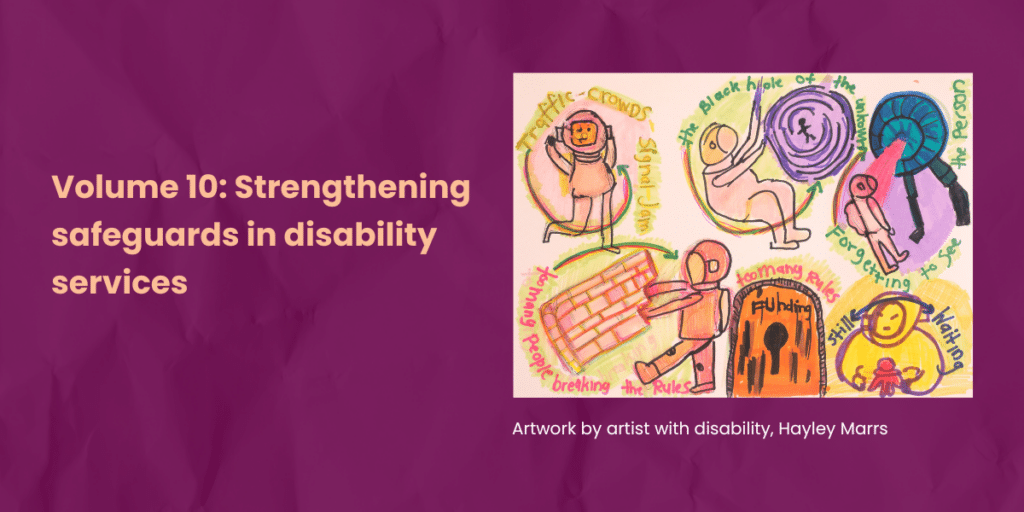
Artist Statement
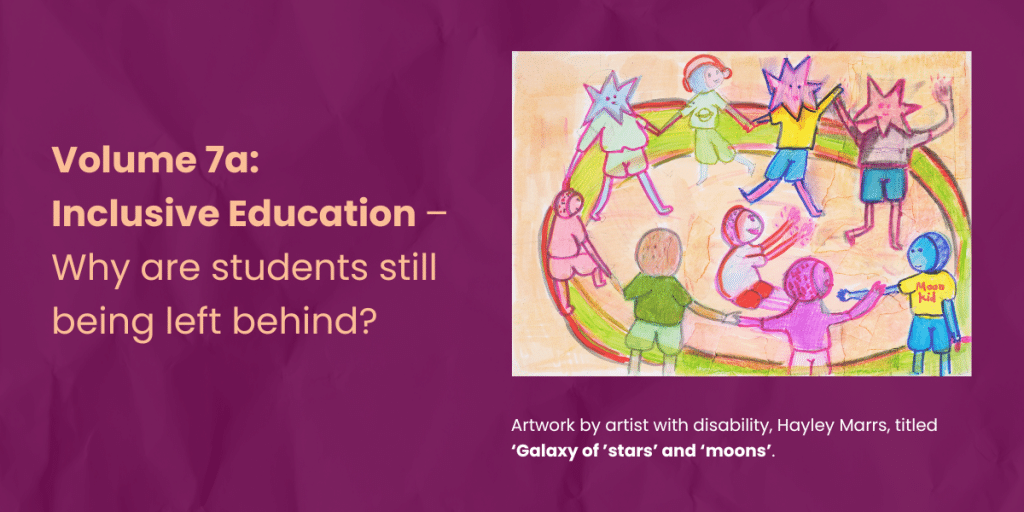
“My artwork represents a circle of ‘stars’ and ‘moons’, reflecting the various learners in every classroom. To me, inclusivity is having access to the learning, friendship and classroom experiences that suit each individual best, and the acceptance that our differences are what make our galaxy so beautiful”.
– Hayley Marrs
Inclusive Education
Volume 7 is a massive volume, covering inclusivity in education, employment and housing. In this post, we start by looking at the first section – inclusive education (Vol 7a).
Education shapes opportunities across a lifetime. For children and young people with disability, inclusive education can improve academic outcomes, wellbeing, employment prospects and participation in community life. Volume 7a examined how education systems can ensure students with disability are supported to learn alongside peers.
The DRC Recommendations aimed to:
- Improve the schooling outcomes for students with disability by improving enrolment process and access to reasonable adjustments
- Protect students with disability from inappropriate school exclusions
- Strengthen communication and complaints pathways between families and schools
- Develop the capacity of teachers and school staff to deliver inclusive education, and
- Develop a pathway towards ending segregation in education.
QIDAN’s analysis found that whilst some recommendations are beginning to be implemented, there was no tangible progress on key recommendations particularly in areas relating to safeguarding, oversight, and inclusion.
What QIDAN found
Limited action on school exclusions
Recommendation 7.2 calls for stronger measures to prevent the inappropriate use of exclusionary discipline against students with disability.
Governments have taken no action to protect children with disability in these situations, and in fact new statistics show an increase in the percentage of students with disability facing a school disciplinary absence[1]
Progress on reasonable adjustments remains unclear
Recommendations 7.3 and 7.12 focus on improving access and provision of reasonable adjustments at school so students with disability can participate fully in education.
While the Disability Service Plan 2025 – 2028 includes commitments to reasonable adjustments, there hasn’t been any reportable progress.
Segregation continues to grow
Recommendation 7.14 details a step-by-step approach to phasing out segregated education. However, the Queensland Government has recently invested in six new special schools, clearly showing they have no intention to stop the segregation of students with disability.
Where things stand overall
According to QIDAN’s analysis
- 10 (63%) recommendations have no updates on their implementation.
- 4 ( 25%) recommendations are at beginning stages of implementation, and
- 1 (6%) recommendation is in progress.
The DRC made it clear that inclusive education is not simply about access to a classroom — it is about ensuring every student can participate, belong and thrive. Continued action will be needed to ensure children and young people with disability receive the inclusive education they deserve.
Help us track progress
Donations support the development of an accessible, independent online DRC Tracker, and our continued monitoring of the DRC implementation.
Support The DRC Still Matters Campaign
Here are some other ways you can support the campaign.
Read our detailed analysis of Volume 7a in this mini report:
 View PDF (523 KB)
  View Word (2 MB)
[1] Queensland Government. (2025) Question on notice (No. 903). https://documents.parliament.qld.gov.au/tableoffice/questionsanswers/2025/903-2025.pdf